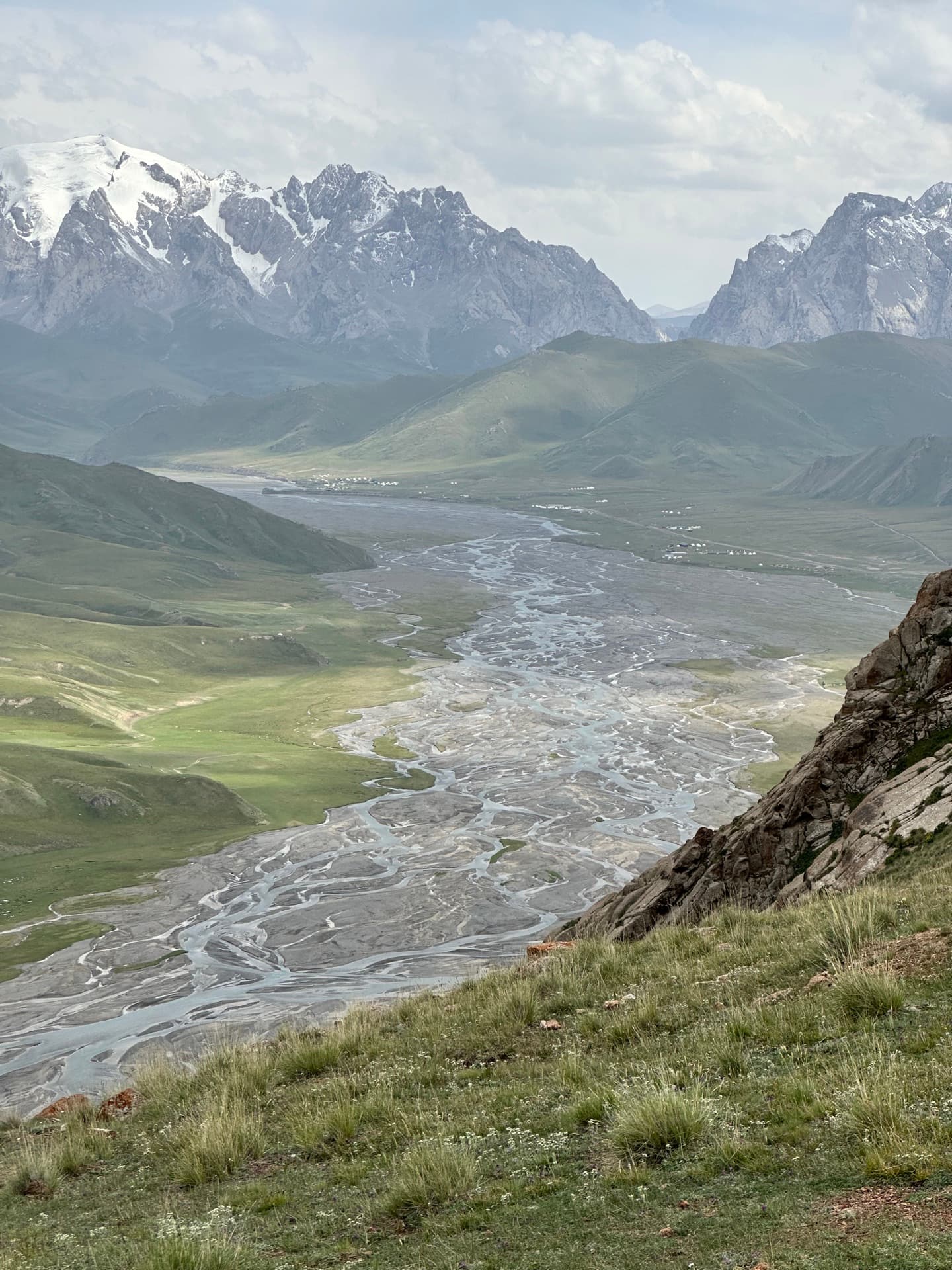
There are still places where you can ride for three days and not see a road. Where the family in the valley has been grazing the same pasture for five generations. Where the sky is wide enough to feel like a physical thing.
Kyrgyzstan is one of those places. And it won't stay like this forever.
The Country at a Glance
Kyrgyzstan is a landlocked republic in Central Asia, bordered by Kazakhstan to the north, China to the east, Tajikistan to the south, and Uzbekistan to the west. It has a population of around 7 million, of which roughly a million live in the capital Bishkek. The rest is mountains, valleys, and steppe — one of the most dramatic landscapes on earth, and one of the least visited.
Over 90% of the country sits above 1,500 metres. The Tian Shan range runs through the centre, with peaks reaching above 7,000 metres. The south — where we operate — is Naryn Province, a high plateau ringed by mountains and cut through by the Naryn River.
The People
Kyrgyz people are the descendants of nomadic herders who have lived on these plateaus for centuries. The tradition of moving between summer and winter pastures — called jailoo — is still practiced by thousands of families today. In summer months, you'll encounter yurt camps at high altitude that are not tourist installations. They're homes.
Hospitality is fundamental to Kyrgyz culture. If you're invited into someone's yurt, you accept. The tea is served with bread and often with kurt (dried salty cheese). Kumis — fermented mare's milk — is offered in summer. Declining politely is fine; accepting is better.
The Landscape
The Naryn highlands are the central feature of our routes. This is a landscape of long valleys, glacial lakes, steep passes, and open steppe that stretches to the horizon. At lower altitudes (1,500–2,000m), the vegetation is dry and golden. Higher up, the meadows are green and dense in summer. Above the tree line, the ground is rocky and the air noticeably thinner.
Key natural features:
- Kel Suu Lake — 3,500m, near the Chinese border, formed by a natural landslide dam
- Kol Tor Lake — 2,720m, glacially fed, ice-blue in colour
- Saar Waterfall — a curtain of meltwater dropping 400m into a remote valley
- Tash Rabat — a 15th-century Silk Road caravanserai in near-perfect condition at 3,200m
The Horses
Kyrgyz horses are a distinct breed — shorter and broader than European riding horses, bred over centuries for altitude, endurance, and difficult terrain. They are not fast horses. They are reliable horses. An experienced Kyrgyz horse will navigate a rocky pass in the dark if it has to. They're the right horse for this landscape.
The relationship between Kyrgyz people and horses goes beyond utility. The national sport — kok-boru, a form of mounted polo played with a goat carcass — is one of the most extreme athletic competitions in the world. The berkutchi tradition of eagle hunting from horseback is another. These are not performances for tourists. They are the continuation of a culture that has always been mounted.
Language and Communication
The official languages are Kyrgyz and Russian. In Bishkek, Russian is more commonly spoken. In rural areas, Kyrgyz dominates. English is limited outside the capital and tourist infrastructure.
On our tours, all communication is handled through our guides. Learning a few words goes a long way: rahmat (thank you), kandaysyz (how are you), jakshi (good) — simple things that are received with genuine warmth.
Currency and Practicalities
The currency is the Kyrgyz som (KGS). As of 2026, approximately 90 som to 1 USD. Cash is essential in rural areas — there are no ATMs outside Bishkek and major towns. Carry enough for the full duration of your trip before you leave the capital.
Mobile connectivity is good in Bishkek and larger towns; non-existent in the highland areas where we ride. This is not a bug. It's the point.
Why Now
Kyrgyzstan is increasingly on the radar of experienced travellers who have done the obvious destinations and are looking for something more unmediated. Infrastructure is improving — roads, guesthouses, tourism services. But the highlands are still genuinely remote. The nomadic traditions are still alive. The landscape is still undisturbed.
In ten years, some of this will have changed. The travellers who go now will have gone before it did.